Thursday, February 19 2026
Selecting, Defining, and Scoping Successful Lean Six Sigma Projects (Part 2)
Written by Jennifer Christie, MBB, Senior Services Manager of Productivity Improvement | Part 2 of a Series on Lean Six Sigma
Lean Six Sigma offers a breakthrough strategy for solving problems and meeting customers’ needs. Most businesses have many project opportunities, but what makes a good project? How does project definition contribute toward success? Here, we will discuss some strategies for selecting and scoping projects, so they are set up to succeed from the beginning.
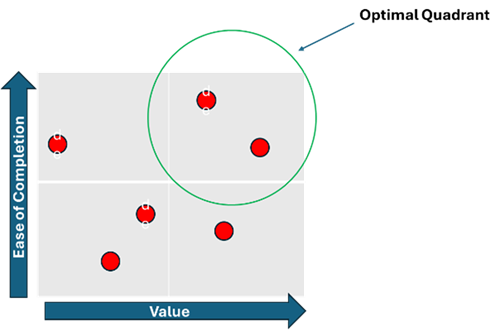
A core tenet of Six Sigma is that projects are aligned with business objectives and customer needs. Understanding the gaps between current performance and these targets is where you start. To discover this, you may look at KPIs, customer feedback, or where you are not meeting goals. Make a list of opportunities where specifications are not being met. Then prioritize that list. A helpful tool can be a prioritization matrix or XY chart to help decide which problems to solve first. Then estimate the ease of completion (difficulty level) and value (impact) to determine where to invest effort.
Example Prioritization Matrix:
Once you’ve identified which opportunities to pursue, the next step is to measure. Is there already a metric in place? Can it be directly measured? Choosing the right metric is critical. It isn’t uncommon to discover that the problem hasn’t been directly measured. In this case, it will be necessary to design and implement a data collection plan. While it may seem like a setback not to have readily available data, it is also a chance to design your data collection so that you can gather possible sources of variation. Consider these questions:
- Does my metric measure the problem directly?
- What other information can I easily gather at the same time (stratified potential causes)?
- How will I collect my data?
- How much data do I need?
- How can I make sure my data is representative?
- Is the measurement system reliable? (…more on that in the next article)
Once you have measured the problem, it is time to compare it to the desired state. Does it meet your customer needs and/or other specifications? How big is the gap? In other words, how capable are you of meeting your customers’ needs? We will discuss Capability Analysis in detail in a future article. For selection and scoping, however, you should at least know where you are versus where you want to be.
Example of Process Exceeding Customer Specifications:
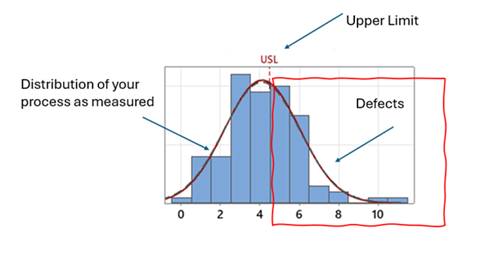
Now that you have a better picture of how well you meet your specifications, you can better understand the value of the project. If the process is performed to standard, what would that be worth? Estimate the financial impact of the project. Consider costs such as scrap, downtime, materials, rework, labor, maintenance, shipping, yield, or any other cost associated with nonperformance. Consider also the softer benefits, which may be harder to quantify, such as customer satisfaction or employee morale.
You now have enough information to describe the problem. The problem statement is important because sets the stage and direction of the project. A good problem statement describes the current state compared to the desirable, identifying the gap. It does not include solutions or causes because those remain to be discovered and proven in the Analyze and Improve phases of the project. The problem statement gives a sense of magnitude and orients the project team to the location and/or time of the issue. Finally, it indicates why the problem is important to solve.
Example Problem Statement:
Dough deliveries to Baking Plant A should arrive within 4.5 hours of mixing. In the last quarter of 2025, 46% of deliveries were late, causing delays in production and machine downtime. Consistently meeting delivery targets will save approximately $172K annually in machine efficiency, scrap, and labor. Furthermore, it will reduce lead time to retail customers by at least one business day, yielding higher customer satisfaction.
Albert Einstein once said that if he had an hour to solve a problem, he would spend 55 minutes understanding the problem and 5 minutes solving it. That is how important defining the problem is.
In addition to defining, setting the scope of the project is crucial. It determines the focus, who will work on the project, and ultimately how long it will take. One of the best ways to define the scope is to draft a SIPOC. SIPOC stands for Suppliers, Inputs, Process, Outputs, and Customers. This high-level map helps determine which areas the project will and will not include, who might be involved, and which products or services to include. To complete a SIPOC, start with the boundaries of the process by identifying 3-5 high-level steps:
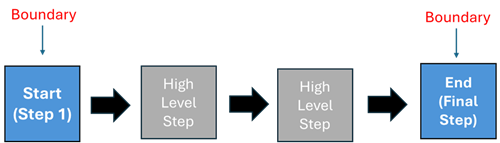
Anything outside of these steps would be considered out of scope and not included in the project. The rest of the SIPOC identifies the suppliers of the process, inputs, and the customers (internal and external) of the process outputs:
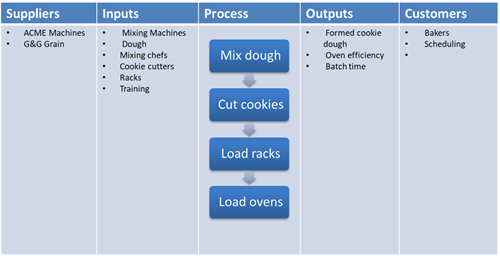
In the example above, you can see that the process starts with mixing dough and ends when the ovens are loaded. The baking of the cookies is out of scope. This is important because it means the project team doesn’t need to investigate the baking process itself, focusing on the steps from mixing to loading. This targets the amount of mapping and analysis that the team must complete. It also identifies bakers and scheduling as customers who can help set specifications to shape project objectives.
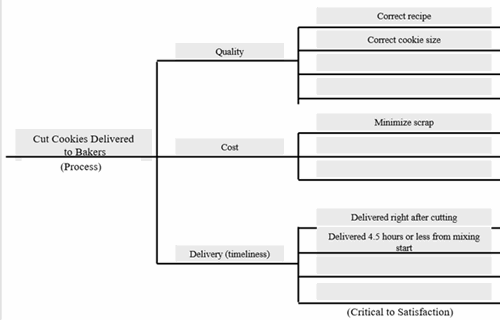
Part of scoping is understanding what is important to the customer. This is known as the “Voice of the Customer” and can be obtained through customer feedback, direct interviews, or directives. Customers generally care about three things: cost, quality, and delivery (timeliness). Identifying what is critical to customer satisfaction helps guide specification limits for the project as well as other aspects of the process that should be considered. For this example, the customer wants cut cookie dough delivered within 4.5 hours, but also wants the cookies fresh (after cutting) with minimal scrap, the correct recipe, and the correct size. While the project may focus on delivery time, the other satisfiers need to be understood so we “do no harm” to these criteria when we improve the delivery time.
Critical to Satisfaction Tree (example):
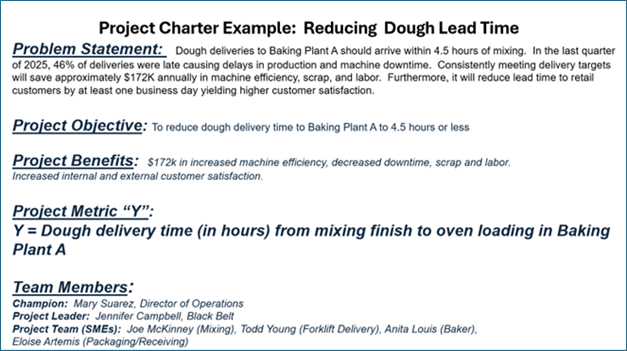
We have now described the problem (Problem Statement), set boundaries/scope (SIPOC), and understand what customers, both internal and external, want (VOC/CTS Tree). Next, we can generate a Project Charter, which will guide the team and serve as our contract with our project Sponsor/Champion. While charters can be refined as we progress in the project, they are a necessary deliverable of the Define phase before we proceed to the Measure phase in the DMAIC structure. The charter should include the following elements:
- Problem Statement: A description of the problem and the gap between the current and desired state
- Project Metric (Y): The targeted metric for the project, a direct measure of the problem
- Objective: The goal of the project, specifically, how the metric (Y) will change
- Benefits: The benefits, both financial and other, expected from completing the project
- Team: A list of the core team members [Champion/Sponsor, Project Lead(s) (Belts), and Subject Matter Experts]
Example Charter:
With a well-defined project, what else can you do to be successful? First, set a timeline with regular check-ins. It is best to scope the project to finish in three to six months from its launch. Projects should be meaningful but not so large as to drag or stagnate a team. It may be necessary to break the project down into smaller projects. Completing projects, realizing results, and celebrating success builds momentum in the organization and builds confidence. Regular check-ins with the Champion are also a key component of project success because they keep the project visible and allow time to remove barriers.
Second, consider who should be on the team and have a formal launch meeting. You can review the charter and make sure everyone is aligned and motivated. This is an opportunity to agree on timelines, roles, and meeting frequencies.
Make the project visible. Publish the launch in your company’s communication and invite leaders and team members to gate transitions. At a minimum, the DMAIC (Define, Measure, Analyze, Improve, and Control) phases should have a formal review from Measure to Analyze, Analyze to Improve, and then at Close. Gate reviews provide a means of communication and help keep the project on track.
A well-scoped project sets a team up for success, and with each successful project, you will build momentum in your continuous improvement culture. As your culture grows, you’ll begin to realize the magic that happens when the organization is aligned and committed to improving.
Want to learn more? Review Part 1 of this series on Lean Six Sigma, which discusses the deployment of a project and creating a roadmap for success. The next article will discuss the Measure phase, how to select a good metric, and how to validate it. In the meantime, please visit the MEP website for more information on our Six Sigma programs. Our experienced team is ready to help!
Writer: Jennifer Christie, 317-275-6810, jennchristie@purdue.edu